About WTSL
Sentinel Landscapes
Sentinel landscapes are geographically delineated areas anchored by at least one high-value military installation or training range and encompass agricultural and/or forestry lands of high importance. A coalition of federal agencies, state and local governments, and non-governmental organizations work with landowners and land managers to advance mutually beneficial land-use goals within the landscape. These goals support the strengthening of military readiness, conserving natural resources, bolstering agricultural economies, increasing public access to outdoor recreation, and enhancing resilience to climate change.
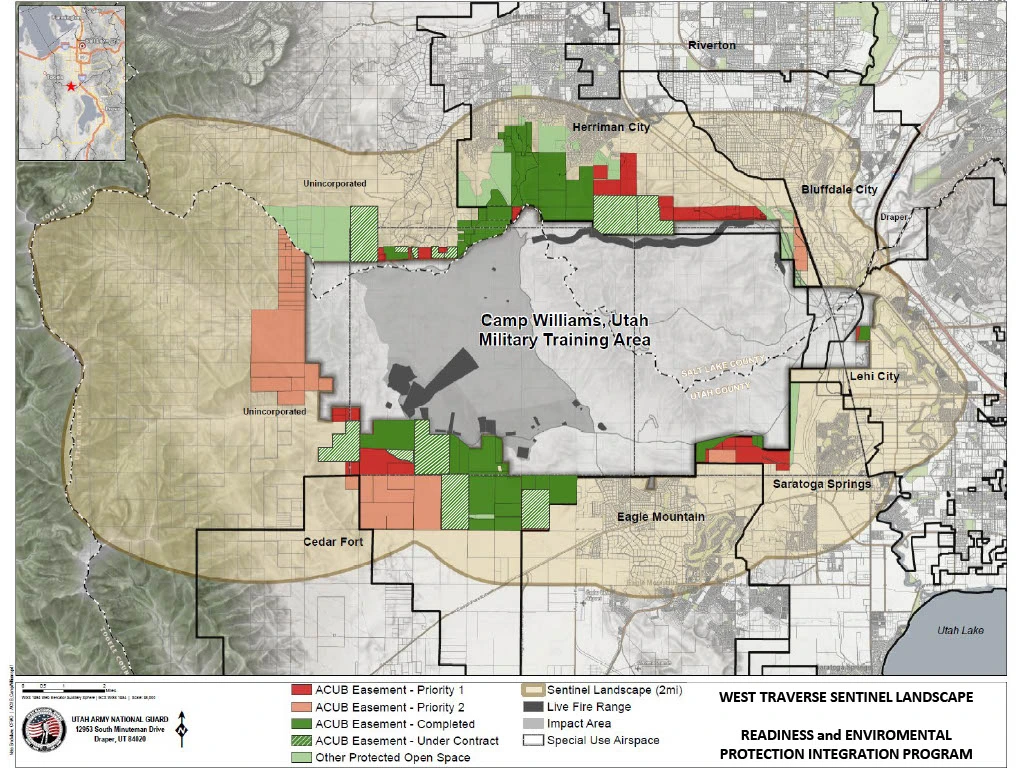
The West Traverse Sentinel Landscape (WTSL) landscape encompasses Camp Williams, agricultural and recreational lands, and is delineated to match the necessary scale to address ecological restoration objectives such as wildfire management, water quality and quantity improvement, and wildlife habitat enhancement.
In 2010, incompatible development at Camp Williams’ fence line impeded routine military training activities. That same year, a wildland fire started on the Camp Williams Machine Gun Range and spread to burn several thousand acres and damage private property along the Northern boundary. These events resulted in a Joint Land Use Study (JLUS) hosted by Eagle Mountain with all of the cities surrounding Camp Williams as participants. The study, completed in 2012, resulted in communal agreement that something had to be done to protect the installation from incompatible development and safeguard the surrounding communities from wildland fire. This led to application to the Department of Defense for an Army Compatible Use Buffer (ACUB) and then the State of Utah to establish a sentinel landscape.
Our Vision
To build a thriving, resilient, and sustainable environment that enables Camp Williams to serve the State of Utah, our Nation and it’s Army, improves community quality of life, and preserves adequate habit for local wildlife and indigenous species to thrive.
Goals
- Protect the training mission at Camp Williams in perpetuity.
- Partner with local communities to create partnerships, reliance, and compatibility.
- Enhance quality of life initiatives in newly created open space.
- Be proactive in protecting wildlife migration corridors and habitat.
WTSL Principles
Principle #2 – Ensuring Compatible Use
Support development within the sentinel landscape for public recreation, quality of life initiatives, or other purposes that are compatible with the training mission of Camp Williams that adhere to accepted land use practices.
Principle #1 – Purchase of Easements and Fee Properties
Acquire land fee simple or a conservation easement through a mixture of state, & only after federal funding or partner match has been secured to complete the transaction.
Principle #3 – Providing Stewardship
Ensure that protections of the sentinel landscape remain in perpetuity. The committee will ensure that investments on property are legally protected, physically inspected, and guarantee the long-term investment into training resources.